

AI risk management is too often seen as a gatekeeper that slows down innovation rather than a tool that enables confident decision making.
This mindset leads to bottlenecks where risk assessments drag on, frustrating business teams eager to deploy AI solutions. The root causes are usually poor ownership, unclear processes, and over-reliance on generic vendor assurances.
To move beyond these blockers, organisations must rethink how AI risk assessments fit into business workflows. This means treating AI use cases as business-led initiatives with structured, tiered reviews and clear evidence expectations from third parties.
The goal is to accelerate low-risk AI adoption while maintaining disciplined oversight for higher-risk scenarios.
The 30-second take
AI risk assessments don’t have to be speed bumps.
When ownership is clear and evidence requirements are tailored, organisations can fast-track low-risk AI projects and focus control resources on more complex cases.
Business leaders must step up as accountable owners and use risk management proactively to enable innovation rather than just prevent failure.
Clear triage, practical workflows, and vendor evidence standards are essential to unlock AI’s full potential safely and efficiently.
Why unclear AI ownership creates risk bottlenecks
One of the biggest causes of AI risk assessment delays is when no one clearly owns the AI initiative. Often, business teams treat AI as a technology project and hand it off to IT, compliance, or risk functions without defining the purpose, benefits, or risks. Control teams then struggle to assess incomplete information and rely on vendor assurances, which may be generic or insufficient.
This fractured approach leads to fragmented reviews, duplicated efforts, and misaligned expectations. Business owners get frustrated seeing risk and control teams as blockers, while those teams feel they are left to clean up unclear or low-quality proposals.
Risk-tiered triage: Matching oversight to AI use case complexity
Not all AI use cases carry the same risk. An internal productivity tool poses a different risk profile than a customer-facing AI system processing sensitive data. Organisations need a clear triage process to classify AI initiatives by risk and apply proportionate oversight.
A risk-tiered approach allows low-risk projects to be fast-tracked with minimal evidence, while higher-risk cases receive deeper scrutiny. This prevents a one-size-fits-all review that unnecessarily delays all AI activity. It also directs risk and assurance resources where they add the most value.
Setting clear third-party evidence requirements
Many organisations rely heavily on vendor or third-party assurances, which often fall short of meeting specific legal, privacy, security, and operational standards. Without clear evidence criteria, risk teams face uncertainty about data flows, model governance, control effectiveness, and compliance with jurisdictional requirements.
Defining upfront what evidence vendors must provide — such as detailed privacy assessments, cyber security documentation, data flow diagrams, and change management policies — creates transparency and reduces repeated follow-ups.
It also helps business owners understand their residual risks and accountability.
Embedding ownership and accountability in AI workflows
AI risk management succeeds when business teams own the initiative from start to finish.
This means clearly documenting the AI use case purpose, expected benefits, customer impact, data involved, and decision-making role. Risk, legal, compliance, and technology teams act as advisors and reviewers, not owners.
Embedding ownership requires a defined intake form, risk triage, evidence checklist, and decision forums with clear roles for approval, escalation, and ongoing monitoring. Training for business and risk teams helps build a shared understanding of responsibilities and practical risk controls.
Learning from bottlenecks: A practical case study
Consider a customer call sentiment analysis AI tool proposed by a business unit relying on a third-party vendor. Initially, no clear business owner defined the risk or purpose. The control teams received generic vendor assurances that overlooked key state privacy laws and lacked cyber security detail.
This led to six months of delays, frustration, and duplicated effort. Risk teams eventually designed a structured AI assessment workflow with clear ownership, triage, and evidence standards. This process fast-tracked low-risk projects and clarified responsibilities, enabling quicker, safer AI adoption.
“AI risk management should help the organisation move faster with greater confidence, not create unnecessary delays.”
Innovation of Risk Thinking: Third-Party, Vendor and Model Supply Chain Risk
One critical Innovation of Risk theme is how AI embedded in third-party vendors and platforms creates a supply chain of risk. Organisations cannot blindly trust vendor assurances since legal obligations, customer impacts, and operational dependencies ultimately remain with them.
Practical questions leaders should ask include: Is AI embedded in a vendor’s service or model? What assurance has the vendor provided, and what independent checks have you done? Do vendor assessments address local legal and privacy requirements? What happens if the vendor changes the model, data, or service design?
Effective risk management requires clear evidence standards, contract clauses for change management, and ongoing monitoring of third-party AI components. This transparency supports better decision making and operational resilience.
Practical questions to assess your AI risk assessment maturity
- Who owns each AI use case from start to finish, and is their accountability documented?
- Do you have a risk-tiered triage process that matches oversight intensity to AI risk levels?
- What evidence standards do you require from third parties, and how do you verify them?
- Are your AI workflows clear, practical, and designed to avoid unnecessary delays?
- How do you ensure that risk, legal, compliance, and technology teams act as advisors, not owners?
- Do you monitor AI use cases after deployment for emerging risks or incidents?
Answering these questions helps organisations move from AI risk bottlenecks to business accelerators.
Clear ownership, proportionate risk assessment, tailored evidence requirements, and a practical operating model unlock innovation with confidence.
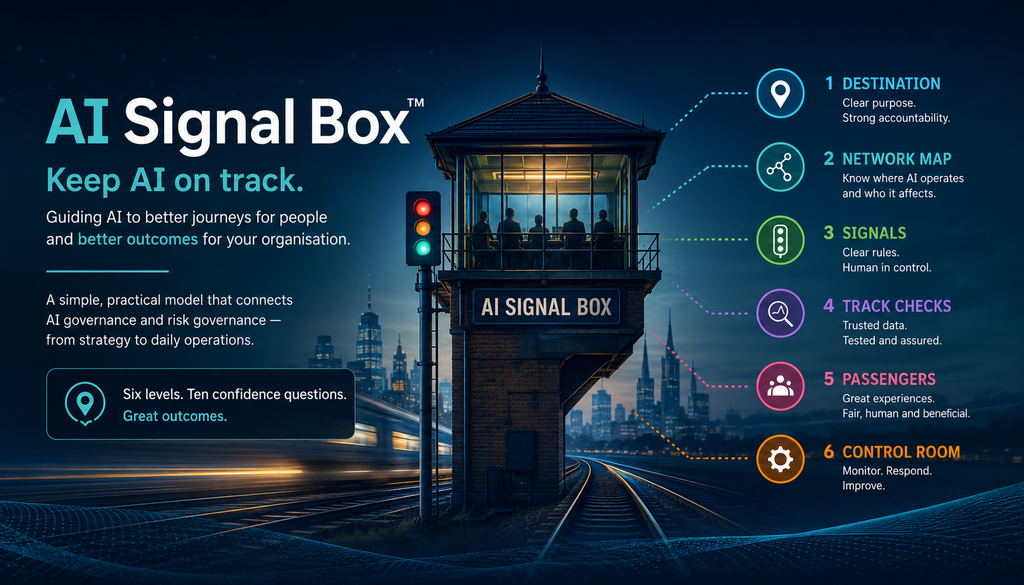
AI Signal Box™ by Innovation of Risk provides AI governance and risk assessment tools to help organisations have better internal risk, governance and assurance discussions. This post is general information only and is not legal, regulatory, audit or professional advice.