

Keep AI on track.
AI Signal Box™ is AI governance and risk assessment software from Innovation of Risk. It helps organisations understand their AI risks, assess governance and turn evidence into clear, accountable action.
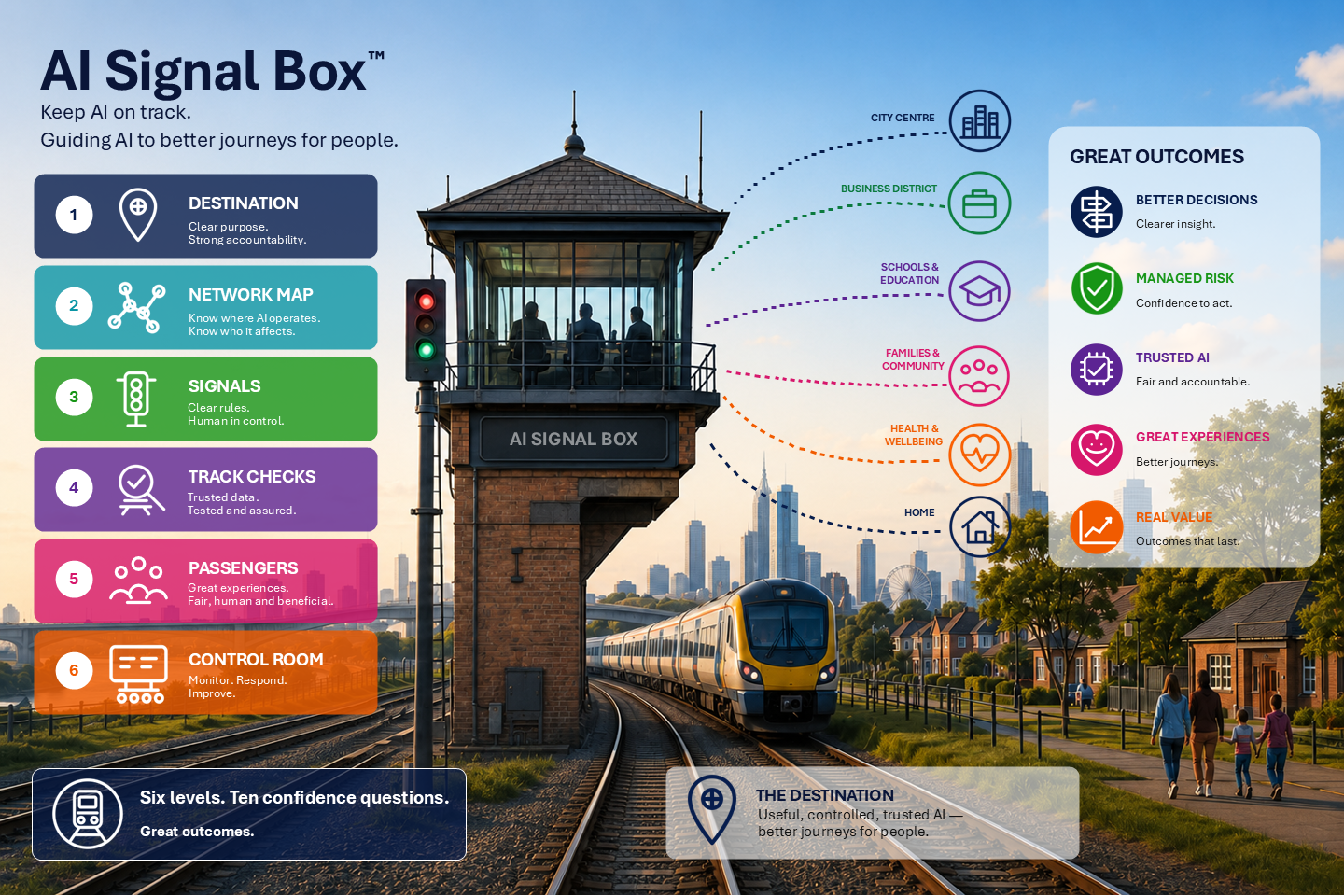
A practical workspace for understanding and improving AI governance
AI Signal Box is designed for boards, executives, risk and governance professionals, technology teams and business owners who need a shared view of how AI is being used and managed.
It connects governance assessment, AI risk, third-party oversight, scenarios, target states, dependencies, action planning and reporting. The aim is not simply to produce a score—it is to help people identify what matters, test confidence in the evidence and decide what should happen next.
Understand before you accelerate
Effective AI governance creates a clear line of sight from purpose to outcomes.
- Clarify purpose, ownership and decision rights.
- See systems, data, suppliers and affected people together.
- Assess evidence, controls, testing and assurance.
- Prioritise actions and monitor improvement over time.
AI opportunity and AI risk travel together
AI can increase the speed, reach and impact of decisions. That makes it important to understand not only what an AI system can do, but how it is governed, what it depends on, who may be affected and how the organisation will respond when conditions change.
AI moves faster than governance
Use can expand before ownership, policy, oversight and escalation arrangements are fully understood. A structured view helps close that gap.
Risk sits across a system
Models are only one part of the picture. Data, people, processes, vendors, controls and downstream decisions all influence the outcome.
Confidence requires evidence
A rating is more useful when the underlying evidence, assumptions, gaps and accountabilities are visible and can inform action.
AI Signal Box™ capabilities
Follow a signal. Explore a capability. Select a connected tool to reveal what it does and its value for managing AI risk.
Survey & distributed assessment
Survey & distributed assessment
What it does
Gather perspectives across roles through surveys, workshops or distributed assessments, then bring responses together for review.
- Gather views
- Review differences
- Identify gaps
Value for managing AI risk
Surface differences in understanding, ownership and confidence early. Use those differences to focus discussion and identify where stronger evidence is needed.
Governance Assessment
AI governance maturity assessment
What it does
Assess governance through structured questions across the six AI Signal Box levels, considering clarity, control and the evidence behind each assessment.
- Assess governance
- Examine evidence
- Prioritise gaps
Value for managing AI risk
Establish a clear baseline, identify weak areas and focus oversight where it is most needed before deployment and as AI use changes.
Risk Assessment & Register
AI risk assessment & register
What it does
Assess proposed or existing AI uses, considering purpose, affected people, data, impacts, controls and evidence. Record risks, ownership and treatment actions.
- Define the use
- Assess exposure
- Record treatment
Value for managing AI risk
Make risk discussions specific to the intended use, so deployment conditions, escalation and treatment decisions are grounded in the organisation’s actual exposure.
Target State Planner
Target State Planner
What it does
Define the governance position you want to reach and examine the gaps from your current assessment. Make improvement priorities explicit.
- Set the target
- Examine the gap
- Prioritise change
Value for managing AI risk
Connect the current risk picture to a practical direction for investment and effort, so maturity goals support the outcomes the organisation needs.
Scenario Lab
Scenario Lab
What it does
Explore plausible conditions, disruptions and changes in assumptions, then consider their implications for AI governance, controls and outcomes.
- Explore a scenario
- Challenge assumptions
- Consider responses
Value for managing AI risk
Challenge confidence before a real event forces a decision. Identify vulnerabilities and response options that a single point-in-time assessment may miss.
Dependency Mapping
Dependency Mapping
What it does
Map connections between AI uses, systems, data, suppliers, controls and obligations to understand how the parts of the operating environment depend on each other.
- Map connections
- Trace consequences
- Focus oversight
Value for managing AI risk
Reveal where a change or failure could spread, where dependencies concentrate and where oversight needs to extend beyond an individual AI model.
3rd Party Maturity Assessment
Third-party group maturity assessment
What it does
Assess governance maturity at the supplier or supplier-group level using a consistent set of questions and supporting evidence.
- Assess capability
- Review evidence
- Identify assurance gaps
Value for managing AI risk
Understand the strength of supplier governance, compare areas of concern and focus assurance conversations on the capabilities that matter to your organisation.
3rd Party AI Assessment Register
Third-party AI assessment register
What it does
Record suppliers’ AI uses, the services affected and their dependencies. Assess individual third-party AI arrangements and the evidence needed for oversight.
- Record AI use
- Assess the arrangement
- Focus due diligence
Value for managing AI risk
See where AI enters through the supply chain, including fourth-party dependencies. Focus due diligence on the specific AI use and its effect on your services.
Action Plan Map
Action Plan Map
What it does
Translate assessment findings and improvement priorities into actions, with ownership, due dates and treatment priorities visible together.
- Define the action
- Assign responsibility
- Track progress
Value for managing AI risk
Keep responsibility and progress visible so that an assessment leads to action and unresolved gaps can be followed up.
Dashboard & Reports
Reporting, dashboards & visualisations
What it does
Bring maturity, risk, evidence, gaps and action progress into visual dashboards and reports, from executive views to more detailed review.
- Bring findings together
- Show what matters
- Support decisions
Value for managing AI risk
Give boards, executives and teams a clear basis for discussing priorities, questioning confidence and following up on improvement.
Model Setup & Mapping
Model setup & framework mapping
What it does
Define assessment scope and context, use the AI Signal Box model and relate the assessment to supported recognised frameworks or mapped custom models.
- Define the scope
- Select the models
- Relate the findings
Value for managing AI risk
Give teams a common foundation for assessment while helping them explain the findings through the governance frameworks relevant to their work.
A signal-box view of responsible AI
The model uses a familiar journey: set the destination, understand the network, establish the signals, check the track, consider every passenger and maintain an effective control room.
Destination
Define the purpose, intended outcome, boundaries and ownership of AI-enabled decisions.
Network Map
Map where AI operates, the data and providers it depends on, and the people or processes it affects.
Signals
Translate policy, appetite, decision rights, thresholds and escalation into clear operating guidance.
Track Checks
Examine controls, data quality, testing, evidence and assurance across the AI lifecycle.
Passengers
Consider fairness, transparency, accessibility, experience and benefit for the people affected.
Control Room
Monitor outcomes and emerging risk, respond to issues and track accountable improvement.
The destination: useful, controlled and trusted AI
Bring your AI governance and risk into view.
Talk with Innovation of Risk about how AI Signal Box could support a clearer assessment, stronger conversations and a practical path from insight to action.
Contact usAI Signal Box is a decision-support aide that helps users assess their own risks, evidence and possible outcomes. It does not provide legal, risk or other professional advice, and it does not replace independent judgement or advice appropriate to your circumstances.