

Artificial Intelligence (AI) risk management is too often treated as a purely protective function—something to stop AI from causing harm. But this defensive approach misses the point. Effective AI risk management should be about enabling better decisions and accelerating value creation. It’s a shift in mindset from risk as a barrier to risk as a competitive advantage.
The 30-second take
Leaders must stop seeing AI risk management as a shield and start treating it as a strategic enabler. This means connecting AI risk to business purpose and performance, assigning clear ownership, demanding tailored evidence beyond generic vendor claims, and embedding ongoing assurance throughout the AI lifecycle. When risk management becomes a tool for success, organisations can innovate faster with confidence, rather than getting stuck in endless reviews and delays.
The limits of the protection mindset
Many organisations approach AI risk management as a way to avoid problems. They focus on ticking boxes, complying with policies, or waiting for a risk function to stamp approval. While these steps are necessary, they often result in slow decision-making, frustrated business units, and missed opportunities.
This protection-first mindset can turn AI governance into a bottleneck. It discourages risk-aware experimentation and fails to link risk management to strategic value. Instead, AI risk should be seen as a decision tool—helping leaders identify where risk is acceptable, where controls need strengthening, and where AI can truly drive better outcomes.
Clear ownership unlocks accountability and speed
Risk management only works when ownership is assigned early and clearly. The business unit implementing the AI must own the risk, supported—not replaced—by control functions like risk, legal, and cyber. Without this, AI initiatives can stall as responsibility is passed around.
Clear ownership means defining the AI’s business purpose, expected benefits, potential harms, and operational accountability from the start. When the business leads with this clarity, risk teams can provide targeted challenge and assurance instead of acting as gatekeepers.
Tailored evidence over generic vendor claims
Third-party AI vendors often provide risk and privacy assurances using boilerplate documentation. Relying blindly on these generic claims undermines effective risk management. Organisations need tailored evidence that addresses their specific legal, privacy, security, and operational context.
This means setting upfront evidence expectations for vendors. What data is used? Are state-based privacy laws adequately considered? How is cyber security maintained? What controls exist around model updates or data changes? Demanding this level of detail helps organisations avoid unpleasant surprises and reduces back-and-forth delays.
Embedding assurance throughout the AI lifecycle
AI risk management is not a one-time checklist. It requires continuous assurance—from initial risk assessment and testing to ongoing monitoring, incident management, and control improvement. Organisations need clear processes to track AI use cases from concept through retirement, ensuring risks remain within appetite as circumstances evolve.
This lifecycle perspective supports resilience and agility. It enables early detection of model drift, fairness concerns, or security issues. It also reinforces accountability by clarifying who can approve, pause, or retire AI initiatives as new information arises.
Practical risk questions for leaders and risk managers
- Who owns this AI use case and its associated risks? Has the business clearly defined purpose, benefits, and harms?
- What level of risk review does this use case require based on data sensitivity, impact, and complexity?
- What specific evidence have we requested and received from vendors? Does it address local laws and operational controls?
- How are we monitoring AI performance, incidents, and unintended consequences over time?
- Is our AI risk management integrated with business decision-making rather than isolated as a control function?
Risk as a tool for success
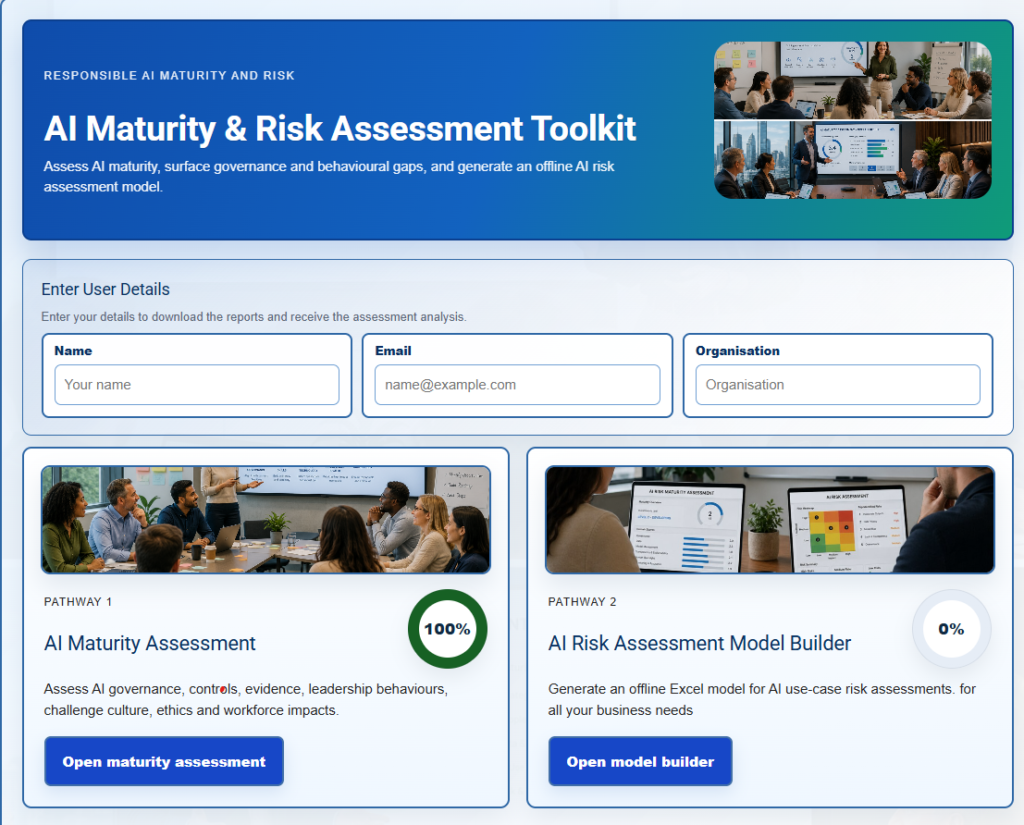
At the Innovation of Risk our AI maturity and risk assessment toolkit challenges leaders to see AI risk management not as protection from failure but as a way to enhance decision quality and accelerate value. It emphasises:
- AI Strategy, Purpose and Accountability: Connecting AI use to clear business objectives and assigning ownership.
- Risk Assessment, Testing and Assurance: Conducting fit-for-purpose risk reviews and continuous assurance throughout the AI lifecycle.
- Third-Party, Vendor and Model Supply Chain Risk: Demanding tailored, credible evidence from vendors and verifying it independently.
- AI Governance and Decision Rights: Clarifying who approves, escalates, and owns AI risks to avoid accountability gaps.
This model helps leaders move beyond compliance to using risk as a strategic enabler, supporting faster, more confident AI adoption.
“AI risk management should help the organisation move faster with greater confidence—not slow innovation with unclear ownership and generic vendor claims.”
Assessing Your AI Risk Management Maturity
To progress, ask yourself:
- Does your organisation treat AI risk as a tool for decision-making and performance, or primarily as a protective barrier?
- Are AI initiatives owned and driven by business teams with risk providing challenge and assurance?
- Do you have a clear process for tailoring evidence requirements to different AI use cases and vendor relationships?
- Is there continuous monitoring and a lifecycle approach to AI risk, rather than one-off assessments?
- How well is AI risk management embedded into governance, culture, and operational decision-making?
Answering these questions honestly will reveal where your AI risk management stands and where to focus improvement efforts. The goal is an approach that balances opportunity with risk, enabling your organisation to innovate responsibly and competitively.
Innovation of Risk have developed a new tool, currently in ‘beta testing’, called the AI maturity and risk assessment toolkit to help organisations have better internal risk, governance and assurance discussions.
Contact us to find out more.